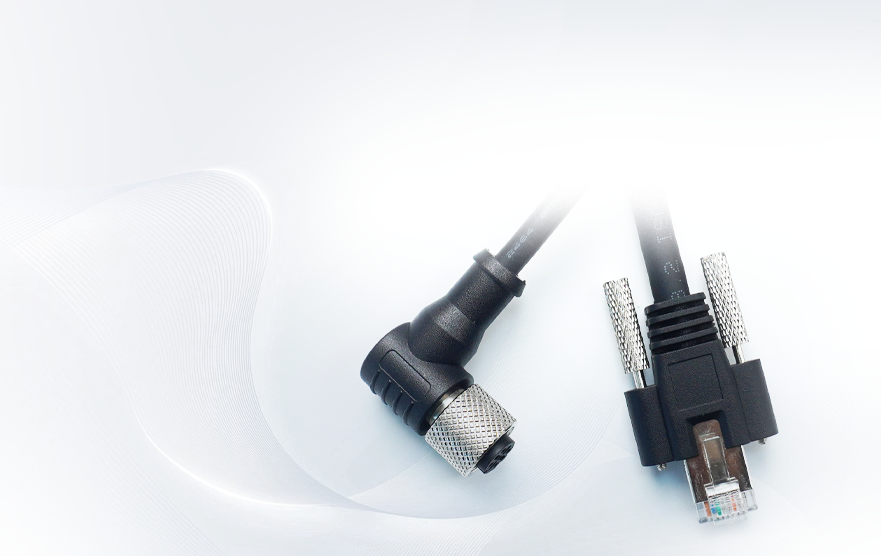
What Is an M12 Connector Cable?
An M12 connector cable is a robust, circular interconnect solution designed for industrial use, where durability, environmental resistance, and reliable signal/power transmission are non-negotiable. The name “M12” comes from two critical details:
- The “M” refers to its metric thread standard, ensuring consistency across manufacturers.
- The “12” denotes the 12mm outer diameter of the connector housing, making it compact enough for tight spaces while still supporting high-performance transmission.
These cables typically feature a connector (male “plug” or female “socket”) at one or both ends, terminated with cables jacketed in PUR (polyurethane) or PVC for flexibility and resistance to oil, abrasion, and chemicals. They adhere to strict international standards—most notably IEC 61076-2-101 for threaded versions and IEC 61076-2-010 (2021) for quick-install push-pull variants—ensuring interoperability across brands.
Key Features of M12 Connector Cables
What sets M12 connector cables apart from standard cables? Their design is engineered for industrial rigor, with these standout attributes:
Wide Pin Count Range
M12 connector cables support 2 to 17 pins, adapting to diverse needs. Low-pin configurations (2–4 pins) are ideal for simple power or sensor signals, such as those from temperature sensors. High-pin configurations (8–17 pins) cater to complex applications like high-speed Ethernet or multi-signal industrial controllers.
IP Ratings for Harsh Environments
Most M12 connector cables boast IP67, IP68, or IP69K ratings—critical for withstanding dust, moisture, and extreme conditions. IP67 means the cable is dust-tight and resistant to temporary submersion (1m depth for 30 minutes), making it ideal for washdowns in food processing. IP68 offers dust-tight protection and durability for prolonged submersion (1.5m depth for 30 minutes), perfect for outdoor sensors or marine applications. IP69K is dust-tight and can withstand high-pressure, high-temperature water jets, common in automotive manufacturing or chemical plants.
EMI/RFI Shielding
Industrial environments are filled with electromagnetic interference (EMI) from motors, generators, and other equipment. M12 connector cables use nickel-plated brass shells or braided tinned copper shields to block EMI/RFI, ensuring signal integrity for sensitive data like real-time machine vision feeds.
Easy Installation
Two common coupling mechanisms simplify setup. Threaded coupling is hand-tightened, providing stability in high-vibration applications such as robotics. Push-pull coupling is tool-free, offering a one-click connection that cuts installation time by up to 80%—great for quick repairs or modular systems.
M12 Connector Coding: What Do A, B, D, X, and Other Codes Mean?
M12 connector cables use coding systems (letter designations) to prevent mis-mating and ensure compatibility. Each code defines the pin layout, signal type, and intended use.
A-Coding is the most versatile option, suitable for sensors, DC power supplies, and 10/100 Mbps industrial Ethernet communications. It supports 2 to 17 pins, making it widely applicable in various industrial scenarios.
B-Coding is primarily designed for fieldbus systems like Profibus, which link sensors, actuators, and controllers in distributed automation networks. It typically features 3 to 5 pins with a standardized layout for power and fieldbus data transmission.
C-Coding, also known as Micro-AC, features a dual keyway design and is tailored for AC power applications. It supports 3 to 6 pins and is optimized for powering smaller automation components such as compact motors, drives, and distributed I/O modules.
D-Coding is specifically for industrial Ethernet applications requiring data transmission up to 100 Mbit/s. It usually has 4 pins, accommodating two twisted pairs for reliable signal transmission, and is compatible with Profinet and EtherCAT systems.
X-Coding is engineered for high-speed industrial Ethernet, supporting data rates up to 10 Gbit/s. With an 8-pin configuration, it’s ideal for demanding applications like real-time video monitoring, high-precision machine control, and 5G infrastructure components such as base stations.
K-Coding is designed for high-power DC applications, featuring 4 or 5 pins and supporting up to 12A and 630V. It’s perfect for electric vehicle charging and high-power industrial equipment.
L-Coding is for AC power transmission, often with 4 or 5 pins. It can handle higher voltages and currents, making it suitable for motors, drives, and other power-hungry equipment.
T-Coding is primarily used for DC power applications, with 2 to 4-pin configurations optimized for carrying higher currents and voltages. It’s ideal for powering DC actuators, sensors, and other industrial devices.
Critical Note: Always match coding between your cable and equipment. For example, an X-coded cable won’t mate with a D-coded port—preventing costly damage or signal failure.
Common Applications of M12 Connector Cables
M12 connector cables are the backbone of modern industrial connectivity. Here are their top uses:
Industrial Automation & IIoT
They connect sensors (pressure, proximity) and actuators (valves, robotic arms) to PLCs (Programmable Logic Controllers). Additionally, they power IIoT devices like asset trackers or predictive maintenance sensors in factories.
Industrial Ethernet
D-coded cables are used for 100 Mbps Ethernet, such as in factory floor networks. X-coded cables handle 10 Gbps Ethernet, ideal for 5G base stations and remote radio units.
Robotics
Withstanding vibration and repeated movement, these cables link robotic joints, cameras, and control systems—ensuring precise, uninterrupted operation.
Alternative Energy
In solar farms and wind turbines, M12 connector cables connect weather sensors, inverters, and data loggers. Their rugged design withstands extreme temperatures, wind, and rain in remote locations.
Transportation
They’re used in railway systems and commercial vehicles to connect sensors, control systems, and communication networks. Their resistance to vibration and shock ensures reliable performance in mobile environments.
Smart Agriculture
A-coded cables connect soil monitoring sensors and irrigation controllers, while D-coded cables enable Ethernet communication between distributed farming devices—supporting automated irrigation and crop monitoring.
M12 Connector Cables vs. Alternatives (M8, RJ45)
How do M12 connector cables stack up against other common industrial connectors?
M12 vs. M8
M8 connector cables have an 8mm housing diameter, making them smaller than M12. They typically offer 3 to 8 pins and are suitable for basic sensors and low-power applications. However, M12 cables support more pins (up to 17), higher power loads, and superior water resistance (IP67+ vs. M8’s limited submersion capability). Choose M8 for tight spaces with low-power needs; opt for M12 for rugged, high-performance applications.
M12 vs. RJ45
RJ45 connectors are common in office and data center networks, with a rectangular 8-pin design. While they support high data speeds, they lack M12’s environmental protection (most unshielded RJ45s have no IP rating). M12’s circular design, IP67+ ratings, and vibration resistance make it better for industrial settings, while RJ45 is ideal for indoor, stable environments.
How to Choose the Right M12 Connector Cable
Selecting the right cable requires considering these key factors:
Coding & Pin Count
Match the cable’s coding to your equipment (e.g., X-coding for 10 Gbps Ethernet, B-coding for Profibus). Choose a pin count that fits your signal/power needs—2–4 pins for simple tasks, 8+ pins for complex systems.
Environmental Requirements
Select an IP rating based on your environment: IP67 for general industrial use, IP68 for submersion risks, and IP69K for high-pressure washdowns. For corrosive environments (e.g., chemical plants), choose cables with stainless steel shells or nickel-plated brass for corrosion resistance.
Cable Type
- Twisted Pair Cables: Best for data transmission (Ethernet, Fieldbus).
- Ethernet Cables (Cat5e, Cat6a): Ensure stable high-speed communication for X-coded or D-coded cables.
- Power Cables: High-current variants for K-, L-, or T-coded applications.
Material & Durability
- Shell Material: Nickel-plated brass (affordable, corrosion-resistant) or stainless steel (extreme strength for harsh conditions).
- Cable Jacket: PUR for flexibility and oil/abrasion resistance; PVC for cost-effective, indoor use.
Maintenance Tips for M12 Connector Cables
To maximize lifespan and reliability:
Keep mating surfaces clean: Use compressed air or isopropyl alcohol to remove dust, dirt, or metal particles.
Use protective caps: Cover unused connectors to block contaminants.
Avoid misalignment: Ensure proper mating to prevent debris trapping or pin damage.
Check for corrosion: Regularly inspect cables in humid or chemical environments—replace if signs of rust or damage appear.
Choose the right IP rating: Prevent moisture ingress by matching the cable’s IP rating to your environment.
Final Thoughts
M12 connector cables are the gold standard for industrial connectivity, offering durability, versatility, and reliable performance in harsh conditions. Whether you’re building a factory automation system, setting up 5G infrastructure, or powering robotic arms, understanding their coding, features, and applications is key to choosing the right cable. By prioritizing compatibility, environmental resistance, and quality, you’ll ensure seamless connectivity that stands up to the demands of Industry 4.0.
Ready to find the perfect M12 connector cable for your project? Explore trusted manufacturers’ offerings and consult technical specifications to match your unique needs—from coding and pin count to IP rating and cable type.