

Industrial Ethernet Cable: Features, Types & Selection Guide
Time:Feb 02,2026
Source:
In industrial settings—where extreme temperatures, moisture, vibration, and electromagnetic interference (EMI) run rampant—standard Ethernet cables fall short. They can’t withstand the harsh conditions or deliver the consistent, real-time data transmission critical for manufacturing, energy, and transportation operations. That’s where industrial Ethernet cables come in. But what exactly is an industrial Ethernet cable, and why is it indispensable for modern industrial connectivity? Let’s break it down.
What Is Industrial Ethernet Cable?
At its core, an industrial Ethernet cable is a specialized data transmission cable designed explicitly for harsh industrial environments—far beyond the controlled conditions of office IT networks. Unlike commercial-grade Ethernet cables, which prioritize cost and basic performance, industrial Ethernet cables are engineered to endure extreme temperatures, moisture, dust, chemical exposure, vibration, and EMI. They maintain reliable data flow for critical applications like factory automation, power substations, outdoor security systems, and vehicle-mounted equipment.
While industrial Ethernet cables share the same basic data-transmission principles as commercial cables (e.g., Cat 5e, Cat 6, Cat 6A, or fiber optic variants), their construction, shielding, and materials are upgraded to meet the rigors of industrial use. They ensure deterministic, low-latency data delivery—essential for real-time control systems like Programmable Logic Controllers (PLCs) and Supervisory Control and Data Acquisition (SCADA) systems.
Key Characteristics That Define Industrial Ethernet Cables
What sets industrial Ethernet cables apart from their commercial counterparts? These critical features address the unique pain points of industrial environments:
- Robust Shielding for EMI/RFI Protection
Industrial spaces are filled with noise sources—arc welding machines, AC drives, and power equipment—that cause electromagnetic interference (EMI) and radio frequency interference (RFI). These disrupt data transmission, leading to packet loss or delays. Industrial Ethernet cables solve this with advanced shielding options, including:
- F/UTP (Foil/Unshielded Twisted Pair): A single foil layer around all twisted pairs, ideal for moderate interference.
- S/FTP (Shielded/Foil Twisted Pair): Individual foil shielding for each pair plus an overall braided shield—perfect for high-interference zones (e.g., power substations).
- SF/FTP (Shielded/Foil/Foil Twisted Pair): Dual outer shielding (foil + braid) and pair-level foil for maximum protection in extreme EMI environments like oil refineries or mines.
- Durable Jacket Materials for Harsh Conditions
The jacket (outer layer) of an industrial Ethernet cable is built to resist physical damage, chemicals, and temperature extremes. Common materials include:
- PVC: Cost-effective for light industrial settings, resistant to oil but limited to temperatures between 0°C and 75°C.
- PUR (Polyurethane): Mechanically tough—abrasion, tear, and chemical-resistant—ideal for machining, stamping, or outdoor applications.
- TPE (Thermoplastic Elastomer): Withstands extreme temperatures (-50°C to 125°C), sunlight, ozone, and saltwater—great for marine, outdoor, or vehicular use.
- FEP: Offers the widest temperature range (-50°C to 125°C) and chemical resistance, suited for aerospace or harsh chemical environments.
- Flexibility and Mechanical Strength
Many industrial applications (e.g., robotics, towlines) require cables to bend, twist, or move repeatedly. Industrial Ethernet cables address this with:
- Stranded Conductors: More flexible than solid conductors, with high-flex variants featuring 19–60 strands per conductor (vs. 7 strands in commercial cables) for up to 10 million flex cycles.
- Armored Jackets: Optional metal or plastic armor protects against crushing, impact, or rodent damage in rugged areas.
- Compatibility with Industrial Protocols
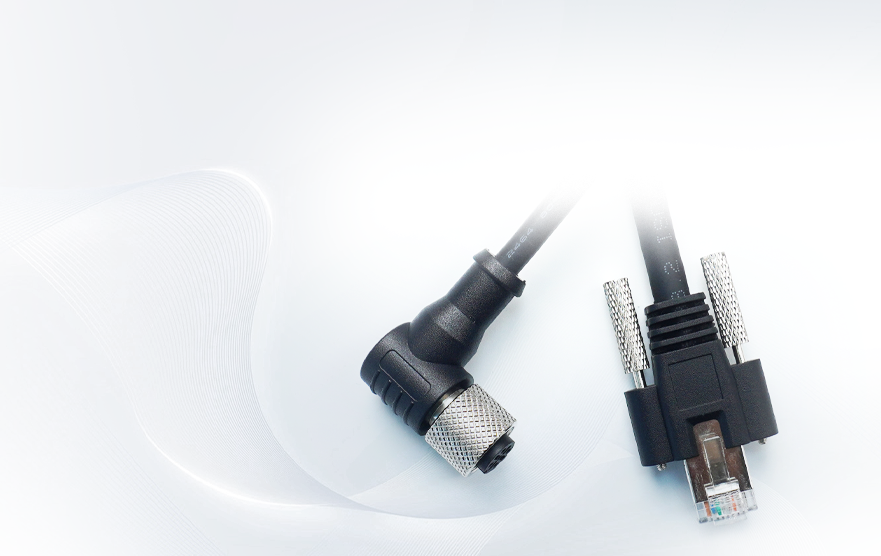
Industrial Ethernet cables must work seamlessly with automation protocols like PROFINET, EtherCAT, EtherNet/IP, and Modbus TCP. They’re paired with connectors (e.g., M12 coded connectors, RJ45) that match protocol requirements—for example, M12 X-coded connectors for 10Gbps Cat 6A cables or M12 D-coded connectors for 100Mbps PROFINET/EtherCAT systems.
Common Types of Industrial Ethernet Cables
Industrial Ethernet cables come in variants tailored to specific applications:
- Twisted Pair (Cat 5e/Cat 6/Cat 6A): The most common for short to medium distances (up to 100m). Cat 5e supports 1Gbps, Cat 6 supports 10Gbps, and Cat 6A delivers 10Gbps at full 100m lengths.
- Fiber Optic Cables: Ideal for long distances (over 100m) or high-EMI environments (e.g., rail, mining). Immune to EMI, they support speeds up to 100Gbps and are lightweight and flexible.
- Towline/Moving Cables: Designed for repeated motion (robots, conveyor systems) with enhanced flexibility, wear resistance, and minimal bending radius.
Why Industrial Ethernet Cables Matter
Using commercial cables in industrial environments leads to costly downtime: signal loss, cable failure, and disrupted operations. For example, a factory relying on unshielded commercial cables near welding equipment may experience PLC communication errors, halting production. A power substation using non-EMI-resistant cables could face data delays that compromise grid stability.
- Ensuring 24/7 reliability in extreme conditions.
- Delivering real-time, error-free data for critical control systems.
- Reducing maintenance costs by withstanding wear, corrosion, and interference.
How to Choose the Right Industrial Ethernet Cable
When selecting an industrial Ethernet cable, align it with your environment and needs:
- Assess the Environment: Use the MICE classification (Mechanical, Ingress, Climatic, Electromagnetic) to identify hazards (e.g., vibration, moisture, high EMI).
- Match Protocol Requirements: Ensure the cable/connector combination supports your protocol (e.g., M12 A-coded for EtherNet/IP, M12 Y-coded for hybrid power/data).
- Prioritize Shielding: Choose S/FTP or SF/FTP for high EMI; F/UTP for moderate interference.
- Select the Right Jacket: PUR for abrasion resistance, TPE for extreme temperatures, FEP for chemicals.
- Plan for Speed/Bandwidth: Cat 6/Cat 6A for 10Gbps, fiber optic for long distances/high bandwidth.
Final Thoughts: What Is Industrial Ethernet Cable, and Why You Need It
An industrial Ethernet cable isn’t just a “tough” version of a commercial cable—it’s a purpose-built solution for the unique challenges of industrial connectivity. It ensures that critical data flows reliably, even in the harshest conditions, powering Industry 4.0 and Industrial IoT (IIoT) initiatives.
Whether you’re upgrading a factory floor, installing outdoor security systems, or maintaining a power substation, choosing the right industrial Ethernet cable is key to minimizing downtime and maximizing efficiency.

Apply Here For A Custom Made Solution

Shenzhen Torvenics Electronic Co.,Ltd.
615 Block A, No.11 Tangkeng Road,Henggang Longgang Dist,Shenzhen China