

Custom M8 Connector Cable for Better-Fitting Industrial Systems
Time:Aug 14,2026
Source:
A custom M8 connector cable helps OEMs and automation integrators solve a common problem: a standard cable may connect two devices, but it does not always fit the machine, environment, or installation process. Cable length may be excessive, the connector may point in the wrong direction, the jacket may not suit the working environment, or the pin configuration may not match the intended signal design.
Torven provides connector and cable-assembly solutions for industrial automation, sensors, actuators, test equipment, machine vision, medical equipment, and transportation systems. For compact industrial devices, a customized M8 cable can help turn a basic connection into a more reliable and maintainable part of the overall machine design.
M8 circular connectors are widely used for low-voltage and low-power signals in sensor and actuator applications. Their compact threaded coupling helps create a secure field connection, while custom cable assembly options give equipment manufacturers more control over routing, protection, identification, and long-term serviceability.
Moving Beyond Standard Cable Lengths
One of the most common reasons to choose a custom M8 connector cable is cable length. Off-the-shelf cable assemblies are often supplied in standard dimensions such as 1 m, 2 m, 5 m, or 10 m. These options are convenient, but they may not match the actual distance between the sensor and the control unit.
An overly long cable can create several issues:
- Excess cable must be coiled, tied, or stored inside the equipment
- Cable routing becomes more difficult in compact machine frames
- Excessive slack may increase the risk of snagging or abrasion
- Installation time can increase during assembly or maintenance
- A less organized wiring layout can make troubleshooting more difficult
A custom cable length allows an OEM to design a cleaner wiring path from the beginning. This is valuable in compact automation equipment, robotic grippers, packaging lines, test fixtures, hydraulic systems, and sensor-based inspection stations.
The goal is not simply to make the cable shorter or longer. It is to provide enough length for correct routing, service access, and movement, while avoiding unnecessary cable management inside the machine.
Matching Connector Orientation to the Equipment Layout
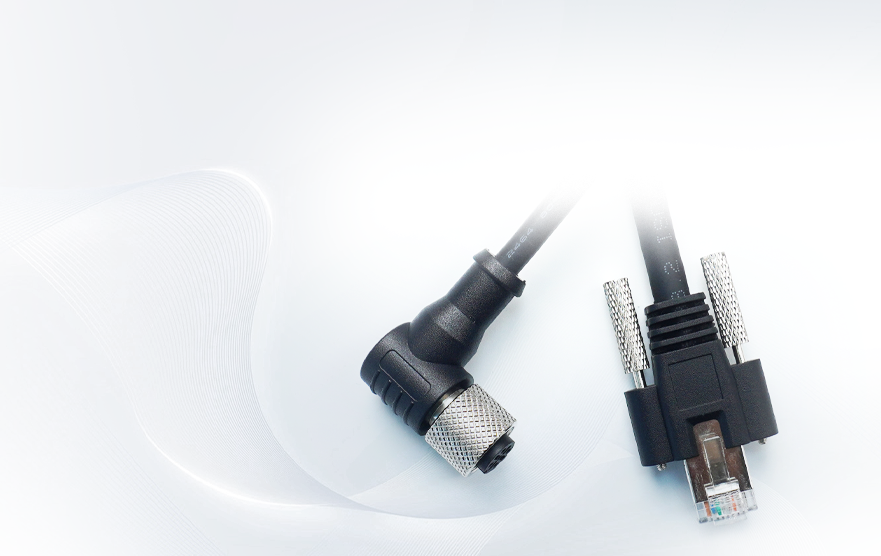
Connector orientation can have a major effect on installation quality. In a tight machine enclosure, a straight M8 connector may require more rear clearance than the design allows. In other cases, a right-angle connector can reduce cable stress and help prevent the cable from bending sharply at the connector exit.
A custom M8 Connector Cable can be configured with straight, angled, molded, or field-installable structures based on the application. Torven offers M8 options with 3-, 4-, 5-, 6-, and 8-pin configurations, adjustable angle connectors, shielded versions, and IP67-rated protection for applicable designs.
A right-angle M8 connector may be a better fit for a sensor mounted near a moving conveyor, a pneumatic valve installed inside a compact machine frame, or an actuator positioned close to a protective guard. A well-chosen connector orientation can help protect the cable, improve assembly access, and create a more professional final installation.

Selecting the Right Electrical Configuration
Customization is also important when the cable must carry a specific combination of power, sensor, communication, or control signals. Pin count, coding, connector gender, cable shielding, and conductor specification should all be selected according to the connected devices and the operating environment.
M8 cable assemblies can be configured with different coding options, including A-coded, B-coded, and D-coded versions for relevant applications. The connector’s coding and pin arrangement should always match the device interface and communication requirement before a cable assembly is specified.
For sensor-level applications, an unshielded cable may be suitable when the installation environment is electrically clean. However, equipment that operates near motors, variable-frequency drives, switching power supplies, or high-current conductors may require a shielded cable design to reduce the risk of electromagnetic interference.
A custom M8 connector cable can also be specified with different jacket materials. PVC may be appropriate for general stationary applications, while PUR or TPE cable jackets may be considered for projects involving abrasion, movement, oil exposure, or more demanding environmental conditions. Torven lists PVC, PUR, and TPE as available cable-jacket options for customer-specific cable sets.
Supporting Easier Installation and Maintenance
A machine’s cable design affects more than initial assembly. It also influences service time, replacement accuracy, and the risk of installation mistakes in the field. A custom cable can include specific lengths, connector orientations, color requirements, and identification details that make the final system easier to install and maintain.
For OEMs producing several machine models, customized cable assemblies can help standardize each model’s wiring architecture. Instead of relying on general-purpose replacement cables,
technicians can use assemblies designed for the correct routing path and device interface.
This approach is particularly useful for:
- Compact factory automation equipment
- Sensor-equipped robotic tools
- Hydraulic control systems
- Agricultural and construction machinery
- Test and measurement fixtures
- Automated packaging and labeling equipment
- Industrial monitoring devices
By standardizing a custom cable design for each equipment type, OEMs can simplify bill-of-material management and reduce the chance that an incorrect cable will be installed during assembly or maintenance.
Building a Scalable M-Series Connection Strategy
An M8 connector is highly effective for compact sensor and low-power signal connections, but it may not be the right interface for every part of an industrial system. As equipment becomes more complex, engineers may need larger connectors for higher pin counts, more demanding data transmission, or applications with more substantial power requirements.
For these situations, M12 Connector Cable solutions can complement M8 cable assemblies within the same automation architecture. M12 connectors are commonly used when a project requires a larger circular interface for industrial sensors, actuators, communication systems, or more demanding field connections.
Using both M8 and M12 connections strategically allows OEMs to select the most appropriate interface for each device rather than forcing a single connector size across the entire machine. M8 can support compact sensors and small actuators, while M12 can serve larger or more complex connection points where added capacity is required.
A custom M8 connector cable is therefore not just a purchasing variation. It is a practical engineering tool for improving cable routing, equipment fit, environmental protection, installation consistency, and long-term maintenance. By defining the electrical, mechanical, and environmental requirements before production, OEMs can create cable assemblies that support a more reliable and scalable industrial system.

Apply Here For A Custom Made Solution

Shenzhen Torvenics Electronic Co.,Ltd.
615 Block A, No.11 Tangkeng Road,Henggang Longgang Dist,Shenzhen China