

How M8 Connector Cable Factories Support Modern Industrial Automation
Time:Aug 13,2026
Source:
When OEMs and system integrators search for reliable m8 connector cable factories, they are often looking for more than a standard sensor cable. They need a manufacturing partner that can support compact designs, application-specific configurations, stable quality, and scalable supply for industrial automation projects.
Torven supplies connector and cable-assembly solutions for automation technology, industrial data transmission, machine vision, testing equipment, medical devices, and transportation equipment. For projects that use sensors, valves, compact actuators, and control modules, M8 connector cables provide a practical connection method in installations where space and reliability are both important.
An M8 connector cable uses an 8 mm threaded coupling structure to create a secure connection for low-voltage and low-power signal applications. It is widely used in sensors, electromagnetic valves, instrumentation, pressure transmitters, construction machinery, production automation equipment, and other compact industrial systems. M8 configurations may include 3-, 4-, 5-, 6-, or 8-core options, allowing factories to match the cable assembly to different signal and control requirements.
Supporting Sensor Networks in Compact Equipment
Industrial automation depends on reliable communication between sensors, controllers, and actuators. In compact machines, a cable assembly must fit within limited mechanical space while remaining easy to install and maintain. This is one of the main reasons buyers work with experienced M8 connector cable factories.
M8 connector cables are commonly used with photoelectric sensors, proximity switches, temperature sensors, pressure sensors, and compact control devices. Their threaded locking design helps create a stable connection in equipment exposed to vibration, repeated operation, or demanding industrial environments.
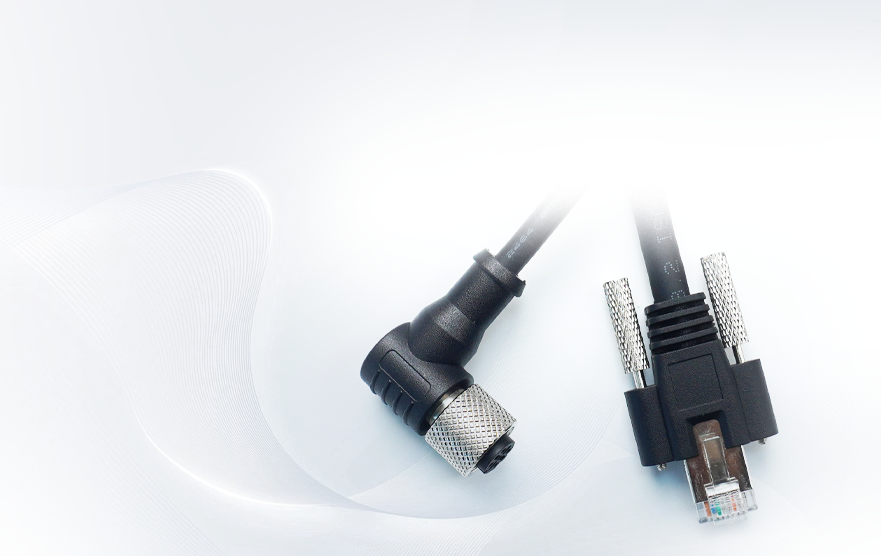
For factory automation projects, the correct cable assembly may require a specific pin count, cable jacket material, shielding option, length, or connector orientation. A straight connector can be suitable when sufficient rear clearance is available, while a right-angle version can reduce bending stress and save installation space in narrow cabinets or machine frames.
Working with a factory that supports these variations helps OEMs avoid using unsuitable standard assemblies simply because they are readily available.
Improving Reliability in Robotics and Mobile Machinery
Robotics and mobile industrial equipment place special demands on cable assemblies. Sensors and actuators may be installed on moving arms, automated grippers, hydraulic systems, or confined mechanical assemblies. The cable connection must remain dependable while fitting into a design that often leaves little room for oversized components.
A customized M8 Connector Cable can be configured for these requirements with suitable core counts, connector genders, cable lengths, and straight or angled molded structures. Torven lists M8 cable solutions with 3-, 4-, 5-, 6-, and 8-pin versions, optional shielding, adjustable angle connectors, and IP67 protection for applicable designs.
These characteristics make M8 cables a suitable option for applications such as robotic end-of-arm tooling, construction machinery, hydraulic machine tools, automated handling systems, and compact sensor modules. In each case, the goal is not only to connect a device, but to maintain an organized and serviceable wiring system throughout the equipment lifecycle.
For buyers comparing M8 connector cable factories, it is important to confirm whether the supplier can support both prototype quantities and recurring production programs. This flexibility can shorten the transition from engineering validation to full-scale equipment manufacturing.

Enabling Flexible Industrial Control Systems
Industrial control systems often combine multiple sensors, solenoid valves, switches, and field devices within one machine. When every connection uses a different cable style or routing approach, installation and maintenance become more difficult. M8 connector cable assemblies help standardize compact connections across these distributed devices.
For example, a packaging machine may use M8 cables to connect sensors that detect material position, carton presence, motion limits, or pneumatic actuator status. A small adjustment in cable length or connector orientation can improve cable routing and reduce unnecessary slack inside the machine.
M8 cables can also be used in instrumentation and test systems where space is limited and a secure low-power connection is required. The availability of multiple coding and pin-count options gives engineers more freedom to design a cable assembly around the required signals rather than forcing the application to fit a single generic product.
Choosing a Factory for Custom Requirements
Not all M8 cable requirements are identical. A sensor manufacturer may need short, molded cable assemblies for a compact product line, while a machine builder may require longer cables with specific connector orientations for cabinet-to-field wiring. The right manufacturing partner should be able to evaluate the complete assembly requirement instead of focusing only on the connector interface.
Key considerations include:
- Pin count and coding compatibility
- Male or female connector configuration
- Straight, right-angle, or panel-mount structure
- PVC or PUR cable-jacket requirements
- Shielded or unshielded construction
- Required cable length and labeling
- Environmental protection and application conditions
- Prototype, small-batch, and volume-production needs
Torven’ M-series connector portfolio includes M5, M8, M12, M16, and M23 options, with straight, angled, and flange-type threaded connector structures available across relevant designs. This range can help OEMs develop an expandable interconnect strategy as machines add more sensors, communication points, or power requirements.
Creating a Scalable Connectivity Strategy
While M8 connectors are highly effective for compact sensor and actuator connections, some automation projects require larger interfaces for more demanding signal, power, or environmental requirements. As a system expands, engineers may need to combine M8 cables with other circular connector solutions rather than relying on one connector size throughout the entire machine.
For applications that require a larger and more robust sensor, actuator, or industrial communication interface, M12 Connector Cable solutions can provide a natural next step within the same broader connectivity strategy. M12 cable assemblies are commonly considered when equipment requirements exceed the space, pin-count, or application scope of a compact M8 interface.
Choosing the right M8 connector cable factory is therefore about building long-term supply confidence, not simply purchasing a cable. A capable manufacturer can help OEMs align connector types, cable construction, routing needs, and production volumes across prototypes, custom machinery, and ongoing automation programs. With the right M8 cable solution, industrial equipment builders can create cleaner connections, simplify installation, and support more reliable field performance.

Apply Here For A Custom Made Solution

Shenzhen Torvenics Electronic Co.,Ltd.
615 Block A, No.11 Tangkeng Road,Henggang Longgang Dist,Shenzhen China